
Why "Can Read" Doesn't Mean "Can Live"
Every ophthalmologist has encountered this paradox: the surgery was flawless, and the chart shows good visual acuity, yet the patient returns dissatisfied. They often say: "You told me I would read. But I can not!" In reality, it means "I can read – but I hate how it feels".Why does this disconnect occur? The answer lies in the…
Oleksii Sologub
Strategic Advisor in Premium IOL Adoption
From the AVSologub archive · preserved with its original publication date

Every ophthalmologist has encountered this paradox: the surgery was flawless, and the chart shows good visual acuity, yet the patient returns dissatisfied. They often say: "You told me I would read. But I can not!" In reality, it means "I can read – but I hate how it feels".
Why does this disconnect occur? The answer lies in the fundamental difference between threshold capability and visual comfort.
The Science: Acuity Reserve or The Rule of "3x"
By applying the concept of Acuity Reserve - traditionally a Low Vision concept to modern refractive cataract surgery, we can uncover why a single line of visual acuity on the intermediate or near chart makes a critical difference in a patient's quality of life.
What we measure on the eye chart is a stress test. It determines the Minimum Angle of Resolution (MAR) - the absolute limit of what the eye can resolve with maximum effort.
However, visual rehabilitation research proves that real life demands a reserve. For fluent, sustained reading, the object must be 2 to 3 times larger than the patient's threshold acuity.
The Math of Comfort: On a standard logMAR chart, achieving this 3x safety buffer requires a difference of roughly 5 lines
Threshold: The patient can read the letters.
Comfort: The patient enjoys reading the letters. These two states are often 5 lines apart.
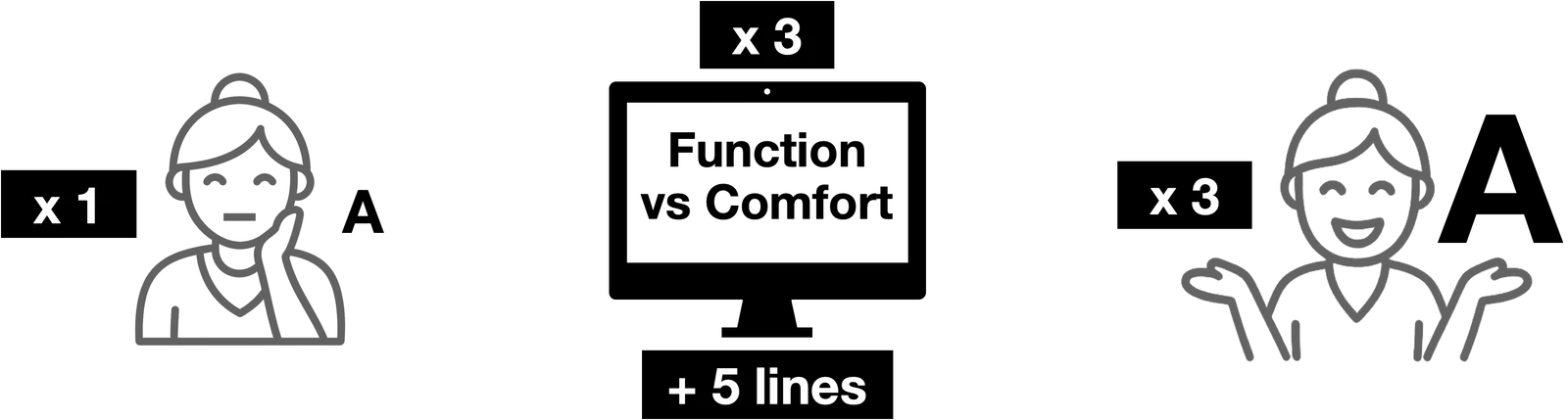
The Trap: Functional vs. Comfortable Vision
When we tell a patient, "You can read this line," we are often describing functional vision, not comfortable vision.
Functional Vision (Threshold): The patient can decipher the text, but only with effort, reduced blinking, and fatigue. It is a "survival" vision - adequate for checking a price tag, but exhausting for reading a book.
Comfortable Vision (Reserved): The patient forgets about their eyes. They just work.
The "Standard" Reality: At intermediate distances (e.g., a computer monitor), a standard monofocal lens in the best possible conditions may provide only a ~2x reserve. This allows the patient to function, but often without the comfort required for long sessions.
Why One Line is a Chasm
In distance vision, losing one line on the chart rarely compromises functionality (e.g., driving) because objects are large. However, at near and intermediate distances, where angular margins are tight, gaining just one extra line creates a critical "neurological buffer".
This single line of improvement transforms the patient's experience from "I can do it if I try" to "I just do it".
Conclusion: Redefining the Promise
We must stop equating threshold acuity with success. When counseling patients, do not just promise they will "be able to read." Instead, explain that the goal is to move their daily tasks from the "borderline" zone into the "comfort zone".
True success isn't the smallest line they can read in your exam room. It is the line where they can live their life without thinking about their eyes.
For more details, watch the video: