
The Curse of Knowledge: The Communication Gap Experts Cannot See
An expert can remove every technical term and still fail to explain. The problem is often not the words, but the invisible knowledge the expert assumes the patient already has.
Oleksii Sologub
Strategic Advisor in Premium IOL Adoption
From the AVSologub archive · preserved with its original publication date
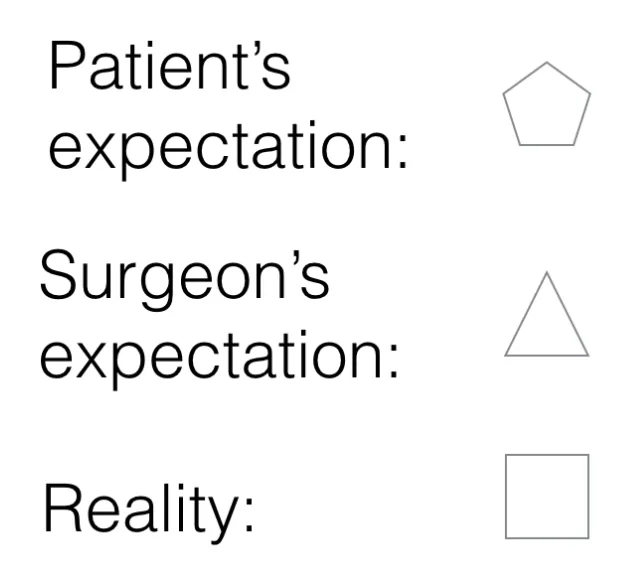
One of the most common causes of poor doctor-patient communication is not medical jargon. It is something more difficult to notice: the curse of knowledge.
Once you know something well, it becomes surprisingly difficult to imagine what it is like not to know it. The missing background disappears from your own view. You explain carefully, use simple words and believe the message is clear — while the person in front of you still lacks the foundation needed to understand what those words mean.
Imagine someone puts a full glass bottle of water into a freezer. You say, “Be careful, it is below zero.” To you, the warning is obvious: water expands when it freezes, so the bottle may break. But if the other person does not know that basic fact, “below zero” explains nothing. Their reasonable response is: “So what?”
Simple language is not the same as a clear explanation
This is the trap for clinical experts. Removing professional terminology helps, but it does not automatically close the knowledge gap. A patient may understand every individual word and still miss the logic connecting diagnosis, options, trade-offs and the life they expect after surgery.
For example, “extended range of vision,” “contrast sensitivity” or even “you may still need reading glasses” can sound straightforward to an ophthalmologist. For a patient, each phrase sits inside a much larger unknown. What will reading actually feel like? Under which light? At what distance? How often will glasses be needed? What compromise is being accepted in return?
If that missing context is not built, more information can create more uncertainty rather than more understanding.
The expert must find what has become invisible
The first practical step is to stop asking only, “How can I explain this more simply?” A better question is: “What must this person already understand for my explanation to make sense?”
Before designing a consultation, patient brochure or website page, identify three things:
- what the patient is likely to believe already;
- which concepts the clinical explanation silently depends on;
- which consequences must be translated into the patient’s daily life.
This changes communication from shortening a technical explanation into building a usable mental model. The goal is not to make the patient an ophthalmologist. It is to give them enough structure to understand what matters, ask better questions and participate in a shared decision.
Why this matters commercially as well as clinically
Patients cannot directly evaluate much of a doctor’s technical work. They can, however, evaluate whether they felt heard, whether the recommendation made sense and whether the outcome matched the picture they had formed before surgery.
That is why the curse of knowledge can quietly lead to mistrust, indecision, rejection of a relevant premium option or dissatisfaction after an objectively successful procedure. The failure appears to be a patient problem: “They did not listen.” Often, the pathway never gave them the knowledge required to listen meaningfully.
Good communication is therefore not a matter of personality and not a final layer added to the consultation. It has to be designed into the complete patient journey — from the first information a patient encounters to the moment clinical value is connected with their own life.
This is one of the starting points of Patient Decision Design Architecture™: expose the assumptions experts no longer see, then rebuild the pathway around what the patient actually needs in order to decide.