
+63%1
PC-IOL unit sell-out
2024–2025
While total unit sell-out in the same recorded IOL portfolio grew 3%.
Evidence
PDDA® draws on hands-on ophthalmic business experience, patient conversations, education and research. These inputs inform the work; a defined project and measured follow-up show what changes in your setting.
Track record · Data on file
This record comes from the ophthalmic distribution business I co-founded and chair. I stepped out of day-to-day operations in 2018; the team continued the operating model through a pandemic and prolonged market disruption, in a market where premium IOLs are paid out of pocket.1
+63%1
2024–2025
While total unit sell-out in the same recorded IOL portfolio grew 3%.
75%1
2025
Three in four across the active partner network.
+59%1
2024–2025
Higher recorded PC-IOL purchasing among accounts purchasing in both years.
+40%1
2024–2025
The number purchasing in at least six calendar months grew 40%.
Indexed growth
Relative change from a common 2024 baseline. No market size, absolute volume or portfolio-share data are shown.
Total IOL sell-out
2024 baseline → 2025PC-IOL sell-out
2024 baseline → 2025Breadth and continuity of purchasing
The recorded pattern combines breadth, regular purchasing and continuity across the account base — not total volume alone.
75%1
Breadth across the active 2025 partner network.
39%1
Positive monthly net PC-IOL sell-out in at least six months of the year.
+40%1
Growth in the number purchasing in at least six months, 2024–2025.
90%1
Confirmed against the current account master; administrative relabelling was reconciled without fuzzy matching.
External context: the 2023 ESCRS Clinical Trends Survey reported that nearly half of respondents did not implant presbyopia-correcting IOLs or used them in fewer than 6% of cases. This is external context, not a directly comparable distributor cohort. Review the ESCRS summary
Data on file. PDDA® Studio, Track Record Analysis TR-2026-01 (2026): internal analysis of aggregated distributor accounting-system unit sell-out records. Sell-out is not implantation, patient outcome or audited national market share. Public figures are limited to rounded percentages and indexed comparisons. Brand, market, absolute volumes, account identities, product-level data and portfolio composition remain confidential.
Discuss the Track RecordMethod and limitations
They are computed from aggregated distributor accounting-system sell-out records. The public figures use rounded percentages and indexed comparisons rather than confidential absolute volumes or portfolio composition.
The underlying commercial records include third-party confidential information. The public case therefore withholds the brand and market and excludes revenue, prices, account names, product-level data and absolute unit volumes.
The methodology, definitions and scope can be discussed in a strategic conversation. The underlying commercial records, absolute volumes and account-level data are not disclosed.
The same baseline cohort was checked against a later consolidated account master. A documented crosswalk resolves administrative name or parent changes only; fuzzy matching was not used.
Triangulated evidence · Data on File
No single dataset proves a universal solution. Together, patient voice, self-reported priorities and market research help identify hypotheses for a premium-adoption diagnosis.
66,000+
Large YouTube comment corpora from the United States, Ukraine and Poland, retained as three separate market datasets.
22,700+
Self-reported visual priorities and willingness to accept trade-offs outside a sales conversation.
10 markets
Three large patient-voice corpora plus targeted qualitative research across seven additional European markets.
What the evidence supports
The themes vary across the analysed sources. They suggest questions about options, trust, payment rules and clinic workflow to investigate in the target market.
Patients can be highly informed and still lack a trusted structure for connecting their life, the clinical options and the trade-offs.
Accounts in the analysed sources describe values and trade-offs being missed, discussed late or explained inconsistently. Those reports suggest pathway questions to test; they are not direct observations of every consultation.
Method note: online commenters and questionnaire respondents are not representative samples of all cataract or RLE patients. The three large corpora support pattern discovery; the seven additional market studies are targeted qualitative desk research. Counts describe the material analysed, not population prevalence. Full research lineage is maintained as Data on File.
1996
Experience built across distribution, clinics, industry and patient education.
22,700+
Self-reported questionnaire data on visual priorities and trade-offs.
15M+
Across two patient-education channels, built by translating clinical complexity into usable language.
Four sources of insight
The method connects evidence that is normally held in separate rooms: the boardroom, the clinic, the consultation and the patient's life.
Oleksii co-founded and chairs an ophthalmic surgical distribution business, while remaining outside day-to-day operations since 2018. The advisory perspective comes from building markets, supporting premium technology adoption and being accountable for execution — not observing it from outside.
Decades of collaboration with private ophthalmic clinics revealed where strategy, patient communication, consultation and operational behaviour stop aligning — and why excellent technology can still underperform.
Years of patient conversations, more than 22,700 IOL questionnaire records from 65+ countries and territories and patient-education work provide a first-party view of how respondents and viewers describe risk, value, visual freedom and compromise.
The thinking has been developed in public: through invited industry work, scientific and business conferences, and editorial publication in international ophthalmology media.
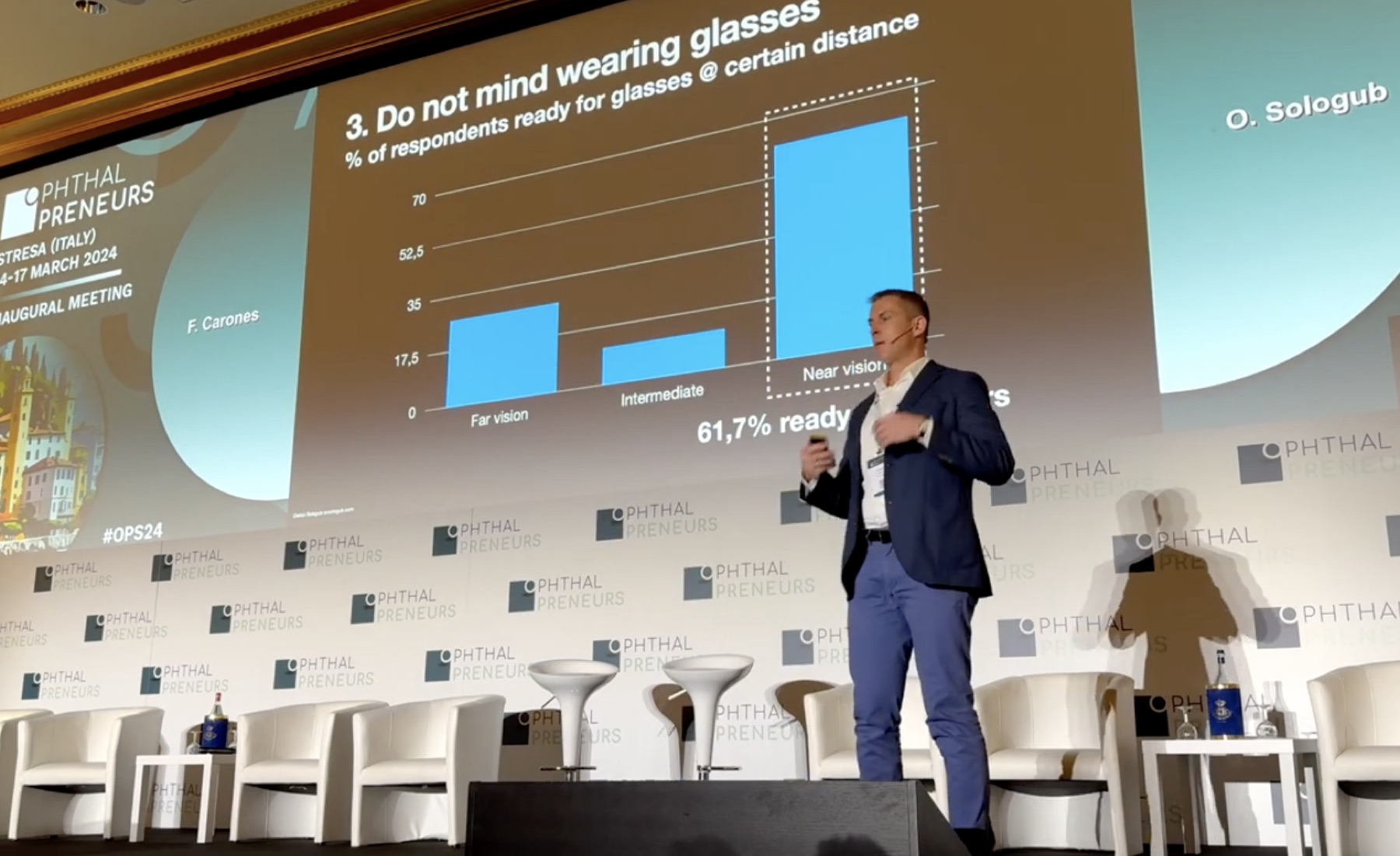
Visible evidence
Published ideas and invited appearances matter because they put the thinking in front of informed audiences — outside a private sales conversation.
Selected work includes publication in The Ophthalmologist and Cataract & Refractive Surgery Today, an invited Bausch + Lomb European keynote, work at the Johnson & Johnson Institute, and conference presentations on patient decisions and premium vision.
Speaking credits document participation, not endorsement of PDDA® or a measured commercial result for the organisations named.
What this evidence means
Operational experience, audience behaviour and self-reported patient inputs give the work a practical starting point. They do not establish the efficacy of a PDDA® intervention or show that one approach works in every market.
The clinic, market and patient reality determine the design. We agree what needs to change, what the team will implement and how the result will be assessed.
Apply the perspective
A 20-minute first conversation can clarify the problem, the available evidence and whether there is a useful project to define.